Operating costs for a warehouse in Almaty$2 account for 15–25% of total business operating expenses. Electricity, heating, and ventilation consume hundreds of thousands of tenge each month. At the same time, the roof of a typical 2,000 m² warehouse is a ready platform for a solar power plant that — at Almaty's current tariffs — pays back in 4.5 years. Let's look at the energy cost reduction tools that actually work.
4.5 years
solar plant payback in Almaty
at a tariff of 37 ₸/kWh — Solarway data. 50 kW plant: from 11.5 million ₸, 300 kW: from 71.5 million ₸
37 ₸/kWh
business electricity tariff in Almaty
Almatyenergosbyт tariff — one of the lowest in Kazakhstan, but continues to rise
up to 60%
reduction in lighting costs
switching from fluorescent lamps to LED — service life also increases 3–5 times
+30%
heat loss through old doors
metal doors without thermal insulation — the main source of heat loss at warehouse loading docks
Why now is a good time to invest in energy efficiency
The electricity tariff in Almaty is gradually rising — the government is moving towards market-based pricing. Investing in solar generation and insulation now means locking in the cost of part of your consumption for 25+ years.
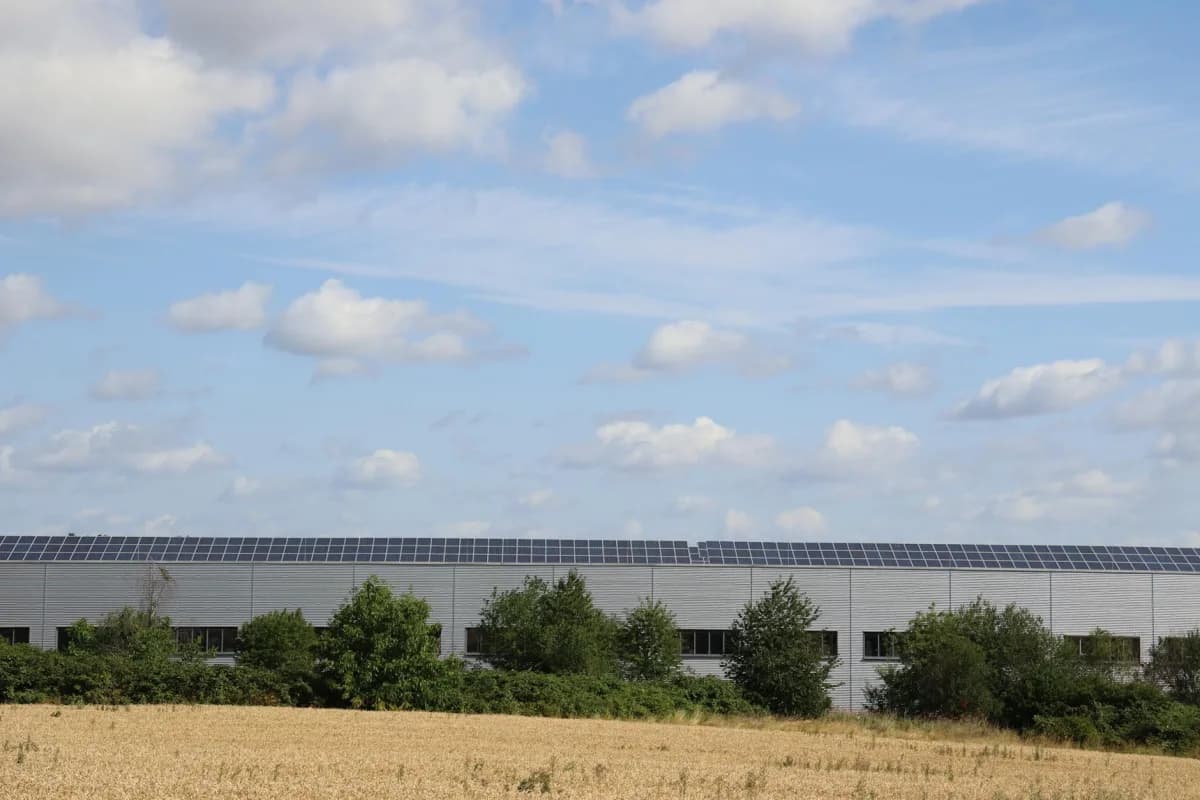
Solar panels in Almaty are an excellent resource: the city receives more than 300 sunny days per year, providing high output by Central Asian standards.
Tool 1: Rooftop solar power plant
How it works
Photovoltaic panels on the warehouse roof generate electricity. There are two options:
Grid-connected (grid-tied): generation goes first to the warehouse's own consumption. Surplus is fed back to the grid (sold). Shortfall is drawn from the grid. The most common option for commercial facilities.
Off-grid: with battery storage — more expensive, but independent of the grid. For warehouses without centralised electricity supply or with an unreliable grid (Almaty region industrial zones).
Prices and output
| Solar plant capacity | Turnkey cost (Almaty 2025–2026) | Annual output | Payback period |
|---|---|---|---|
| 30 kW | from 7.5 million ₸ | ~45,000 kWh/year | ~4 years |
| 50 kW | from 11.5 million ₸ | ~75,000 kWh/year | ~4.5 years |
| 150 kW | from 35 million ₸ | ~225,000 kWh/year | ~4.5 years |
| 300 kW | from 71.5 million ₸ | ~450,000 kWh/year | ~4.5–5 years |
At a tariff of 37 ₸/kWh in Almaty. Source: Solarway Kazakhstan.
Is your roof suitable?
For solar panels you need:
- Roof load-bearing capacity of at least 15–20 kg/m² additional load
- Roof pitch: both flat (with mounting brackets) and sloped 10–30° are suitable
- Orientation: south or south-west is optimal
- Area: 6–7 m² per 1 kW of capacity
A 2,000 m² warehouse with a 2,000 m² roof: installation potential 200–300 kW — which fully covers the base consumption of an average warehouse.
Example: Technodom in Kazakhstan
Tool 2: LED lighting
Why warehouses are still burning money on light
Many warehouse buildings in Almaty were constructed 10–20 years ago and still use fluorescent lamps or metal halide spotlights. Consumption:
- Fluorescent lamp 36 W = 36 W
- Equivalent LED: 12–15 W for the same illuminance
For a 1,000 m² warehouse:
- Fluorescent: ~250 lamps × 36 W × 10 h/day × 300 days = 27,000 kWh/year
- LED: ~250 × 15 W × 10 h/day × 300 days = 11,250 kWh/year
- Saving: 15,750 kWh/year × 37 ₸ = 582,750 ₸/year
Cost of a lighting upgrade for 1,000 m²: 2,000,000–4,000,000 ₸. Payback: 3.5–7 years.
Motion sensors and dusk switches
Areas where staff are not always present (storage, aisles) are fitted with motion sensors — lights switch off after 5–10 minutes. Additional saving: 20–30% on lighting costs.
Tool 3: Thermal insulation and doors
Weak points in warehouse thermal insulation
| Element | Heat loss | Solution |
|---|---|---|
| Metal doors without thermal insulation | 25–35% of building heat loss | Sectional doors with 45 mm foam filling |
| Thermal bridges in frame | 10–15% | Thermal break inserts at connection nodes |
| Roof without insulation | 20–30% | Adding sandwich panels or sprayed PU foam |
| Single-skin corrugated sheet on walls | 30–40% | Installing sandwich panels over existing sheets |
Almaty-specific factors
Almaty has a continental climate: hot summers (up to +38°C), frosty winters (down to −25°C). This means:
- In summer the building needs cooling
- In winter it needs heating
- Quality insulation addresses both requirements
Minimum insulation thickness for Almaty (per energy regulations):
- Walls: 80–100 mm PIR/PU foam panels (thermal resistance R ≥ 3.5 m²·°C/W)
- Roof: 100–120 mm
Tool 4: Heat recovery in ventilation
Warehouses with 10+ staff or high air exchange rates (chemical, food) lose 30–40% of thermal energy through exhaust air. Heat recovery ventilation units (COP 75–90%) return this heat.
| Parameter | Without recovery | With recovery |
|---|---|---|
| Heat consumption | 100% | 40–60% |
| Installation cost (per 1,000 m²) | 0 | 1,500,000–4,000,000 ₸ |
| Payback | — | 3–5 years |
Tool 5: Smart building management (BMS)
A BMS (Building Management System) for a warehouse:
- Automatic zone-by-zone lighting control
- Scheduled heating management (lower temperature during non-working hours)
- Real-time consumption monitoring — anomaly detection
- Remote control via smartphone
Cost: from 500,000 ₸ (basic automation) to 5,000,000 ₸ (full BMS for a large warehouse).
Combined ROI: everything together
For a heated 2,000 m² warehouse in Almaty$2, built in 2026:
| Tool | Investment | Annual saving | Payback |
|---|---|---|---|
| 200 kW solar plant | 48 million ₸ | 11 million ₸ | 4.5 years |
| LED lighting | 5 million ₸ | 1.2 million ₸ | 4.2 years |
| Insulated doors (6 units) | 9 million ₸ | 1.5 million ₸ | 6 years |
| BMS | 2 million ₸ | 0.5 million ₸ | 4 years |
| Total | 64 million ₸ | 14.2 million ₸/year | 4.5 years |
Over 10 years — savings of 142 million tenge on an investment of 64 million.
We design energy-efficient warehouses in Almaty — solar panels and insulation as a package
StroyHub incorporates energy efficiency from the first drawing: insulation, LED, roof preparation for solar panels. Get a savings calculation.