Most clients come with the question "how much does a 1,000 m² warehouse cost in Almaty?" — and only during the design process does it become clear that size itself means nothing without understanding how the warehouse will actually operate. What equipment? What racking? How many trucks at once? Where is your warehouse located — in the Alatau district, near Kaskelen, or in the Turksib area? These questions determine not only the layout, but also the building height, number of gates, floor covering type, and seismic structure.
3.0–3.6 m
forklift aisle width
minimum for a loaded forklift, 4.5 m for comfortable turning in an Almaty warehouse
from 8 to 14 m
height to underside of structure
for warehouses with multi-tier rack storage for reach trucks
1 gate per 500–700 m²
class A standard
for intensive Almaty logistics — 1 per 300–400 m²
9 points
Almaty seismicity
affects column spacing and column cross-sections — layout must be coordinated with the structural engineer
Why Layout Matters Especially in Almaty
Almaty is Central Asia's largest logistics hub. Transit routes from China, Europe, and Russia pass through the city. The growth of e-commerce, pharmaceuticals, and FMCG creates high demand for quality warehouse space. Meanwhile, Almaty's industrial zones (Alatau, Turksib districts, Kaskelen) often have limited plots — there's no option to build "as large as you want", you need to use the area efficiently.
Correct layout in Almaty also means accounting for:
- Wind rose: föhn winds from the south — gates on the lee side preserve heat
- Access roads: access roads in Almaty industrial zones are often narrow, manoeuvring zones need to be planned in advance
- Seismic column spacing: for a 9-point zone, column spacing and cross-sections are set by the structural engineer — the layout must account for this
Step 1: Define the Type of Warehouse Operations
Before designing spans and gates, answer the key questions:
- What is being stored? Palletised goods, unit items, long materials (pipes, rolled steel), liquid/bulk, refrigerated goods?
- How is goods received? From a Euro-truck (12.5 m × 2.45 m), a light van, a container?
- How is goods moved internally? Forklift, reach truck, stacker, pallet jack, conveyor?
- How is it stored? Floor stacking, pallet racking, cantilever racking?
- What is the throughput? How many vehicles per day, what is the storage cycle — day, week, season?
- What is the growth projection? Will the operation expand in 3–5 years? Better to build in capacity now.
These answers form the technical brief for design. Without them, the architect will create an "average" layout that is not optimal for anything specific.
Warehouse Equipment Types and Space Requirements
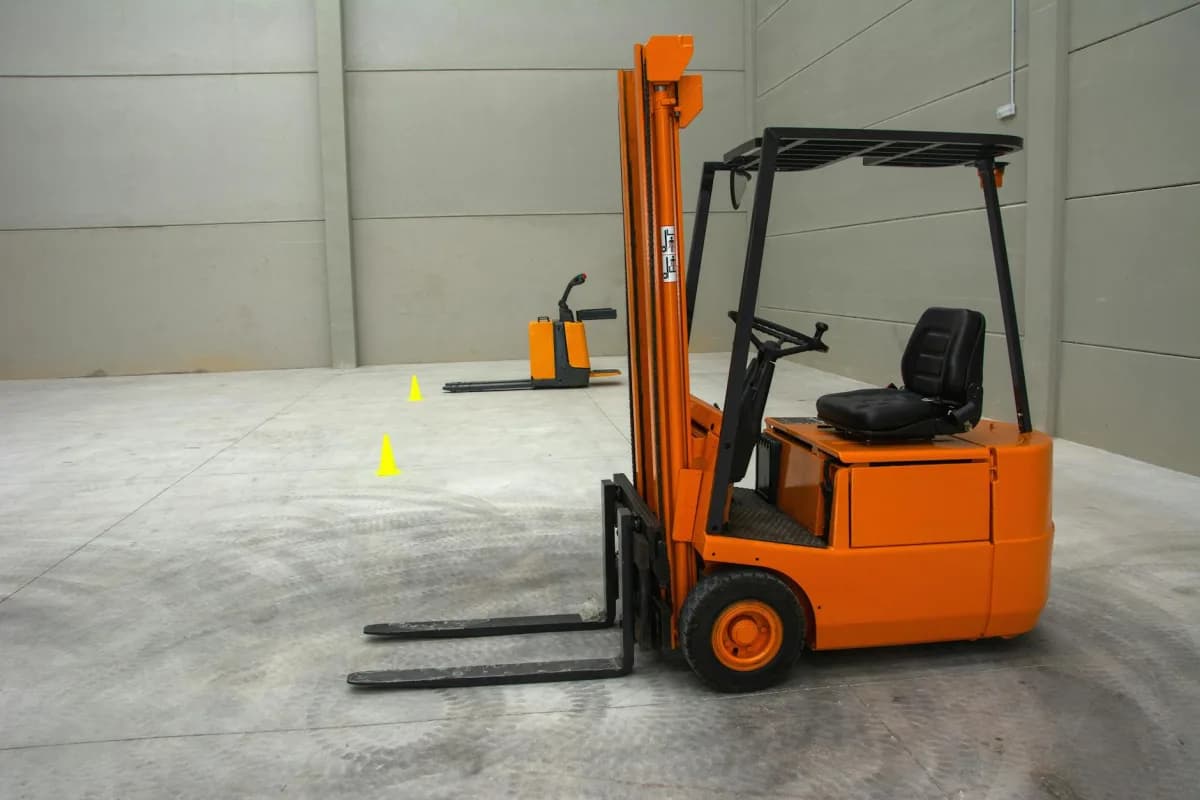
Counterbalance Forklift (conventional)
The most common equipment in Almaty warehouses. Lifts 1.5–5 tonnes, works with EUR pallets (800×1200 mm) and industrial pallets (1000×1200 mm).
Space requirements:
- Stacking aisle width: 3.5–4.0 m
- Through-travel aisle (no turning): 3.0 m
- Lift height: typically 4.5–6.0 m
- Minimum gate height: 4.5–5.0 m
- Minimum room height: 6.0–7.5 m
Almaty specifics: Most Almaty class B and C warehouses operate with conventional forklifts. For cold stores in the Alatau district — gate height is important so heat loss during loading in winter is minimised.
Reach Truck
Used in narrow aisles, works to heights of 10–12 m. Saves floor area by using narrower aisles. Relevant for class A Almaty warehouses (logistics parks on Alatau Highway, Kaskelen).
Requirements:
- Aisle width: 2.5–3.0 m — 1.5 times narrower than a forklift
- Minimum height: 10–13 m to underside of structure
- Ideal for rack storage up to 10 m high
Economic rationale in Almaty: Land in Almaty industrial zones is expensive. A reach truck allows 1.5–2 times more goods to be stored in the same footprint through narrow aisles and height.
VNA Equipment (Very Narrow Aisle)
Specialised equipment for aisles of 1.5–1.8 m. In Almaty, used primarily at large fulfilment centres and class A warehouses.
Requirements:
- Aisle width: 1.5–1.8 m
- Height: up to 16 m
- Special floor requirements: flatness ≤±2 mm per 2 m, curvature ≤0.5 mm/m
- Rail guides in the floor or on racking
Vehicle Types at Almaty Warehouses
| Vehicle Type | Length | Width | Manoeuvring Zone at Gates |
|---|---|---|---|
| Euro-truck (18.75 m) | 18.75 m | 2.55 m | 38–40 m in front of gates |
| Semi-trailer | 14–16 m | 2.5 m | 32–35 m |
| Light van | 6.2 m | 2.3 m | 15–20 m |
| MAZ/KAMAZ (long) | 12–14 m | 2.5 m | 28–32 m |
| 20 ft container truck | 10–12 m | 2.5 m | 25–30 m |
Manoeuvring zone in Almaty industrial zones — the main problem
Gates: Type, Number, Equipment for Almaty Climate
Gate Types
Sectional gates with thermal break — standard for insulated warehouses in Almaty. Winters in Almaty are milder than in Astana (design temperature −25°C vs −38°C), but gates without insulation still create a major thermal bridge.
High-speed gates (roller type, Hormann/Doorhan and equivalents) — for zones with intensive forklift traffic. Open in 0.5–1.5 seconds, minimising heat loss. Relevant for insulated e-commerce and pharmaceutical warehouses.
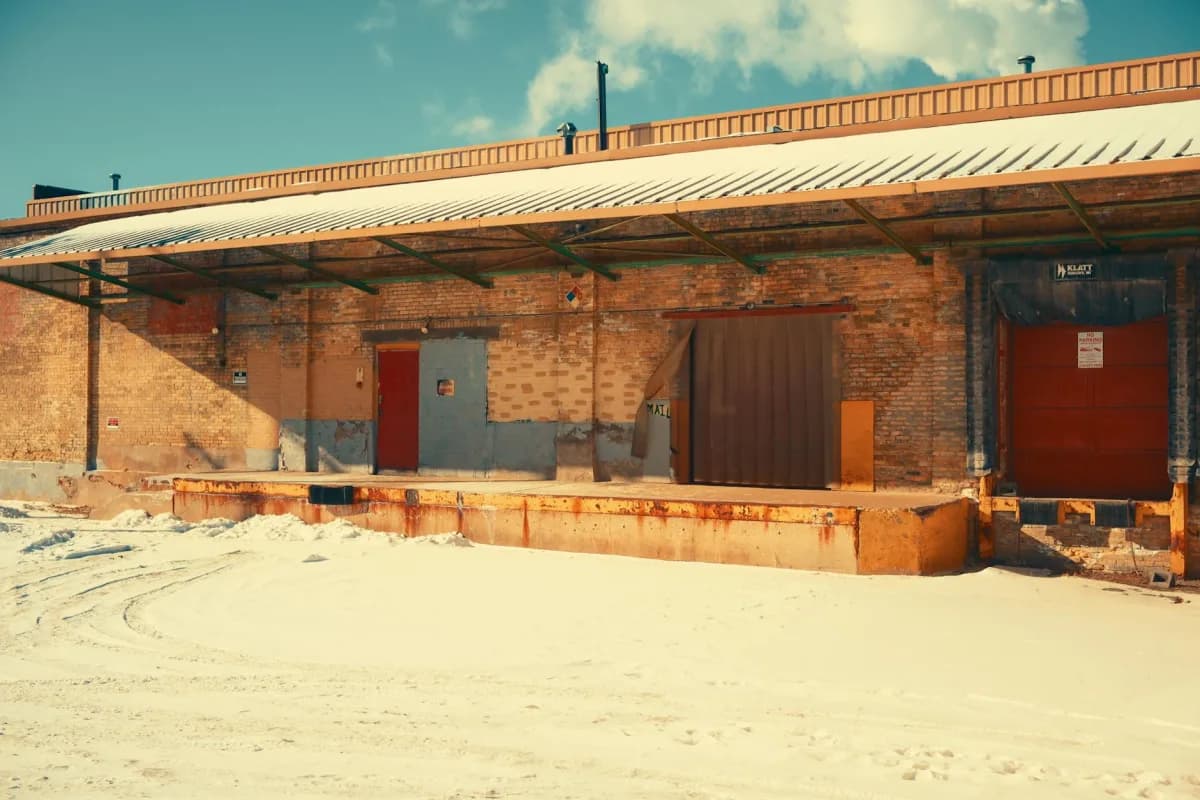
Gates with dock leveller — for loading from trucks without staging on the ground. A ramp with an adjustable dock leveller aligns the warehouse floor level with the truck body. Mandatory for class A warehouses.
Swing gates — cheap, but occupy external space. For warehouses without intensive logistics and where there is no space constraint in front of the gates.
Number of Gates for Almaty Warehouses
| Warehouse Type | Gate Standard | Recommendation for Almaty |
|---|---|---|
| Class A (logistics) | 1 per 500–700 m², minimum 2 | Minimum 2, ideally separate entry/exit |
| Class B (wholesale) | 1 per 700–1,000 m² | 1–2, depending on throughput |
| Cold/freight | 1 per 1,000–1,500 m² | Accounting for vehicle type |
| Production workshop | Per flow calculation | Separate for people and equipment |
Almaty tip: Orient gates to the north or west — away from the dominant southern föhn winds. This reduces draughts when gates are open and heat loss in winter.
Racking and Its Impact on Building Structure in Almaty
Seismics and Racking
In a 9-point seismic zone, racking is an additional source of loading during an earthquake. Tall racking (over 6 m) must be:
- Anchored to the floor (anchor bolts with seismic calculation)
- Cross-braced between rows with horizontal ties
- Designed with inertia loads from goods during tremors in mind
This is a mandatory requirement for warehouses in Almaty that is frequently ignored during racking installation. After the 2023 earthquake, several Almaty warehouses recorded toppled unanchored racks.
Selective Pallet Racking
The most common type. Every pallet is directly accessible.
- Rack depth: 0.8–1.1 m
- Height: up to 12 m (with reach truck)
- Rows parallel to the long axis of the building — optimal scheme
Cantilever Racking
For long materials (pipes, profiles, timber, rolled steel — popular in the Alatau district).
- Arm depth: 0.5–2.0 m
- Aisle between rows: at least 4.0 m for a forklift with long materials
Mezzanine
Effective when warehouse height exceeds 8 m. Relevant for Almaty e-commerce and pharmaceutical warehouses where large and small goods need to be separated.
Mezzanine load: 300–500 kg/m² (light goods) or up to 1,000 kg/m² (reinforced version). Seismic load: A mezzanine in a 9-point zone is additional inertia mass. Seismic load calculation is mandatory.
Warehouse Floor: Requirements by Equipment Type
The floor is the most heavily loaded and expensive-to-repair element of the warehouse. In Almaty, seismics impose additional requirements on floors: expansion joints must account for displacement during earthquakes.
| Operation Type | Floor Load | Flatness | Covering | Reinforcement |
|---|---|---|---|---|
| Pedestrian, pallet jack | 1–2 t/m² | ±5 mm/2 m | Hardener | Mesh |
| Forklift | 3–5 t/m² | ±3 mm/2 m | Quartz topping | Cage |
| Reach truck | 5–7 t/m² | ±2 mm/2 m | Polymer | Reinforced cage |
| VNA equipment | 5–7 t/m² | ±0.5 mm/m | Specialist | Per calculation |
| Heavy equipment | 7–10 t/m² | ±3 mm/2 m | Reinforced slab | Double mesh |
Expansion joints in Almaty's seismic zone
Almaty Warehouse Zoning
A well-planned layout divides the warehouse into functional zones:
- Receiving zone — at the gates with dock leveller, width 6–10 m
- Storage zone — main area
- Picking/assembly zone — for e-commerce or small-wholesale warehouses
- Dispatch zone — may be shared with receiving or separate
- Administrative zone — office, welfare facilities, sanitary facilities (2–5% of area)
- Equipment charging area — separate ventilated room
- Fire egress routes — at least 0.8 m around the perimeter (Kazakhstan standard)
- Emergency exits — per seismic requirements of SN RK 2.03-30
Site Plan: Almaty Context
| Site Element | Requirement | Almaty Specifics |
|---|---|---|
| Truck manoeuvring zone | 38–40 m | Check turning radius before buying the plot |
| Passenger car parking | Code: 1 space per 100 m² warehouse | Separate entrance from freight |
| Fire safety gap | 10–20 m to adjacent building | Per SN RK 2.02-01-2023 |
| Fire access road | 4 m wide, clearance height 4.5 m | Around perimeter or on two sides |
| Landscaping | 10–15% of territory (Almaty master plan) | Confirm in the APZ (architectural planning brief) |
We'll develop a layout for your equipment in Almaty
StroyHub engineers design warehouses in Almaty accounting for seismics, logistics flows, industrial zone constraints, and equipment type. Get a layout solution free with a construction order.
FAQ
What warehouse width is optimal for Almaty plots?
For a forklift the optimum is 18–24 m. For a reach truck — 24–36 m. Column spacing in Almaty with seismics — 6 m (standard) or 12 m (more economical for area, but more expensive structure). The building width must be agreed with the structural engineer accounting for seismics.
How much does layout design cost?
Included in the full project cost (2–5% of construction budget). Layout consultation when ordering construction from StroyHub — free of charge.
Does the layout need to be approved by the fire authority?
Yes. Fire safety requirements determine: fire egress route widths, maximum fire compartment area (for class B warehouse — 5,200 m²), number and location of emergency exits. In Almaty, the fire safety authority (MChS) checks this at facility handover.
Can the layout be changed afterwards?
Changing rack row direction — no problem. Adding new gates — possible, but involves cutting into the structure, panel removal and reinstallation, additional reinforcement. In Almaty (seismic zone) — expert review of structural changes is mandatory.