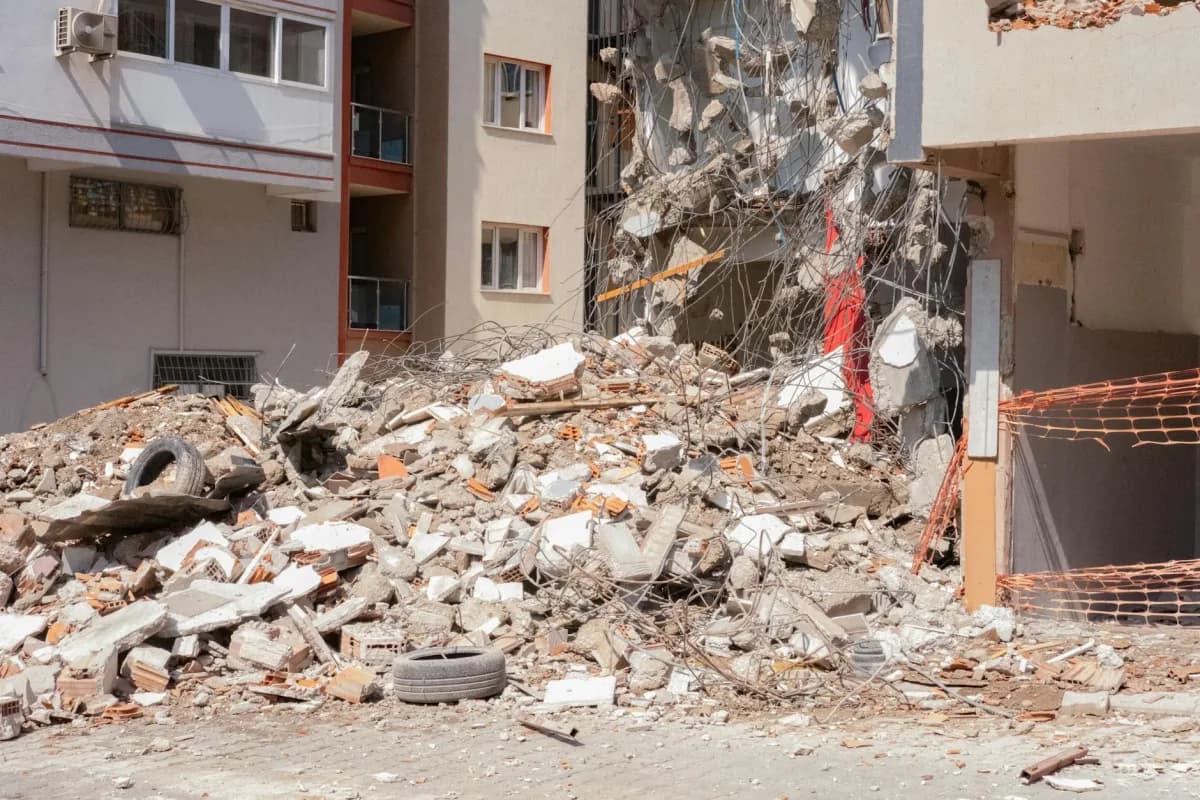
Almaty is one of the cities with the highest seismic hazard among major post-Soviet cities. The design earthquake intensity with a 475-year return period is 8–9 points on the MSK-64 scale, with peak ground acceleration of 0.4–0.5 g. This is a real threat, not a theoretical one: Almaty regularly experiences perceptible tremors, and once every few decades — destructive ones. This is precisely why seismic design is not an option for Almaty industrial buildings — it is a mandatory legal requirement. Let's look at what this means in practice.
8–9 points
Almaty design seismicity
MSK-64, 475-year return period — the highest zone among major Kazakhstani cities
0.4–0.5 g
peak ground acceleration (PGA)
horizontal acceleration at design earthquake — the primary calculation parameter
+10–20%
seismic reinforcement cost
premium added to structural steel costs to ensure seismic resistance
2023
most recent significant earthquake
5.8 magnitude in 2023 — a regular reminder of the relevance of requirements
History of Seismic Activity in Almaty
Almaty (historically Verny) has suffered numerous destructive earthquakes:
- 1887 — Vernensky earthquake, 8 points, significant destruction
- 1889 — Chilik earthquake, 8–9 points
- 1911 — Kemin earthquake, 9 points, one of the strongest in the region's history
- 1966 — 7–8 points
- 2003 — 5 points
- 2015 — 5 points
- 2023 — 5.8 points
The seismically active zone has not gone away. Geologists predict the next major earthquake in Almaty with a high probability within the coming decades.
Regulatory Framework for Almaty
Seismic construction in Kazakhstan is governed by:
- SN RK 2.03-30-2017 "Construction in Seismic Zones" — the primary document
- SN RK 2.03-30-2006 (previous edition, partially applied)
- GOST 31937-2011 — assessment of building technical condition
- Kazakhstan Seismic Zoning Maps — OSR-2015 (general seismic zoning)
- Detailed seismic micro-zoning materials for Almaty — for specific sites
For every building in Almaty, the designer must:
- Determine the design seismicity of the site based on the OSR map and micro-zoning data
- Select the seismic calculation method (quasi-static or dynamic)
- Design structures accounting for seismic loads
- Submit the design to state expert review
How Seismicity Affects the Structure of a Steel-Frame Warehouse
1. Reinforced Connection Nodes
The points where rafters (trusses) connect to columns are critical in seismic events. During a strong earthquake, these nodes bear maximum load.
For a standard region: Bolted or welded connection at standard design load.
For Almaty (9 points):
- Node plates of increased thickness (+2–3 mm)
- Multiple rows of bolts with reduced spacing
- Stiffeners at the connection zone
- Design for horizontal force Q = 0.4–0.5 × G (G — building weight)
2. Seismic Bracing
Bracing elements are additional steel members (usually X-type or V-type diagonals) that ensure building rigidity under horizontal seismic forces.
In the building plan: Horizontal bracing at roof level (along edge bays and across spans) At end bays and midpoint: Vertical bracing panels
Without bracing the building acts like a "house of cards" — at a horizontal jolt the columns sway and lose their load-bearing capacity.
Additional steel consumption for bracing: 8–15% of total frame weight.
3. Reinforced Column Anchorage
Columns are attached to the foundation via anchor bolts. During an earthquake the bolts experience pull-out (from the foundation) and shear loads.
For Almaty:
- Anchor bolts of strength class 8.8 or 10.9
- Anchor plates of increased size
- Embedment depth increased vs standard by 20–30%
- Design for combined tension and shear with seismic coefficient
4. Rigidity Diaphragms
In multi-bay buildings, rigidity diaphragms — rigid planes in the transverse direction — are required for spatial rigidity. These are either steel diaphragms (welded) or moment frames with reinforced nodes.
5. Envelope Structure Fastening
Sandwich panels experience in-plane and out-of-plane inertial loads during a seismic event. Panel fasteners are designed for:
- Out-of-plane inertial load = 0.1–0.2 kN/m² additional to wind
- Relative frame displacement during deformation (the panel must not "fly out")
Fastener screw spacing for wall panels in Almaty is closer than in standard zones.
Calculation Methods for Buildings in Almaty
Method 1: Quasi-Static (Linear-Spectral)
The most common method for warehouse buildings. Seismic load is replaced by an equivalent static horizontal force:
Q = α × K₁ × K₂ × G
Where:
- α — design acceleration (0.4–0.5 g for Almaty)
- K₁ — dynamic coefficient (depends on building vibration mode)
- K₂ — plastic deformation coefficient (0.3–1.0)
- G — building weight with loads
For a single-storey warehouse 8–12 m high with a 24 m span, a typical design horizontal seismic load is 15–25% of the building weight.
Method 2: Dynamic (Time-History Analysis)
Used for complex and tall buildings (>60 m) and unique structures. Requires specialised software (ANSYS, SAP2000, ETABS). Generally excessive for standard warehouses.
Seismic Calculation Software Used in Almaty
Responsibility Categories and Almaty
Buildings in Kazakhstan are classified by responsibility level (CC-1, CC-2, CC-3) per GOST 27751. This affects the design reliability coefficient:
| Level | Building type | Reliability coefficient γn |
|---|---|---|
| CC-1 | Temporary and low-value | 0.8 |
| CC-2 | Standard industrial buildings (warehouses) | 1.0 |
| CC-3 | Unique, critical | 1.1–1.2 |
Most warehouses are CC-2, meaning a standard reliability coefficient of 1.0. For particularly critical facilities (hazardous cargo storage, buildings with permanent occupancy) — CC-3.
Practical Examples: What Changes in the Structural Design
Warehouse 1,000 m² (30×33 m, 8 m height) in Almaty (9 points) vs Shymkent (5 points)
| Element | Shymkent (5 points) | Almaty (9 points) | Difference |
|---|---|---|---|
| Column 30×30 cm, @6 m | 4.5 mm | 6–8 mm | +33–77% material |
| Node plates | 14 mm | 20–22 mm | +43% |
| Column anchor bolts | M24, 4 bolts | M30, 4–6 bolts | ~40% more expensive |
| Bracing (% of steel weight) | 5–6% | 12–15% | +100% bracing |
| Panel fastener spacing | 250–300 mm | 200–250 mm | +20% fasteners |
| Total steel cost increase | Base | +12–22% |
Foundation for Seismic Design in Almaty
- Anchor bolts: M30 class 10.9 with 200×200×25 mm washer plate
- Embedment depth: minimum 700–900 mm in B25 concrete
- Anchorage length is calculated based on pull-out condition at Q = 0.5G per column
Steel Frame Behaviour Under Earthquake
One of the key advantages of steel over concrete in seismic zones is ductility. Steel does not shatter brittlely: it first deforms, absorbing energy, and only then fails (if it ever reaches failure).
Model behaviour under an 8-point earthquake:
- The building sways horizontally
- Elastic deformations at nodes absorb part of the energy
- Under a very strong tremor — plastic deformation in pre-designed "plastic hinges" (zones of plastic steel action)
- The building deforms but does not collapse instantly → time for evacuation
This is fundamentally different from brick masonry or precast reinforced concrete, which fail brittlely and instantaneously when their strength limit is exceeded.
Steel Frame — the Optimal Material for Seismically Active Almaty
Maintenance of Seismic-Resistant Structures
After every earthquake of 4 points or higher, the following is recommended:
| Action | Timeframe | Importance |
|---|---|---|
| Visual inspection of load-bearing elements | Within 3 days | Critical |
| Check of bolted connections with torque wrench | Within 7 days | Critical |
| Roof and junction inspection | Within 7 days | Important |
| Foundation inspection (accessible parts) | Within 7 days | Important |
| Engineering systems check (gas, electrics) | Immediately | Critical |
| Instrumental survey (for 6+ points) | Within 30 days | Critical |
Important: After an earthquake of 6 points or higher, engagement of a licensed organisation for an instrumental survey is mandatory before resuming operation.
StroyHub designs and builds to seismic construction standards
Every StroyHub project in Almaty passes state expert review with seismic calculation verification. Bolt torquing protocols, as-built drawings, warranty — all included.
FAQ
Is state expert review required for a small warehouse under 500 m²?
Formally, state expert review is not mandatory for buildings under 500 m² and 15 m in height in Kazakhstan. But in Almaty's seismic zone we recommend undertaking it even for small projects — it is your protection in disputes.
Can an already-built warehouse be seismically retrofitted?
Yes, this is called seismic strengthening or seismic isolation. Methods include: installing additional bracing, reinforcing nodes with splice plates, installing seismic isolators. Cost depends on the building's condition — can be 20–40% of new construction. Requires an inspection and design.
Why do some buildings in Almaty "look fine" even without seismic design?
Because no serious earthquake has occurred since they were built. A building can stand for 30 years, look normal — and collapse at the first 7-point tremor if seismic resistance was not incorporated in the design.
Which Soviet-era buildings in Almaty are most dangerous?
Brick buildings without antiseismic ring beams (most Soviet-era construction before 1965), large-panel concrete buildings with inadequate panel connections, warehouses with compromised load-bearing structures. For new facilities — only new construction to current standards.