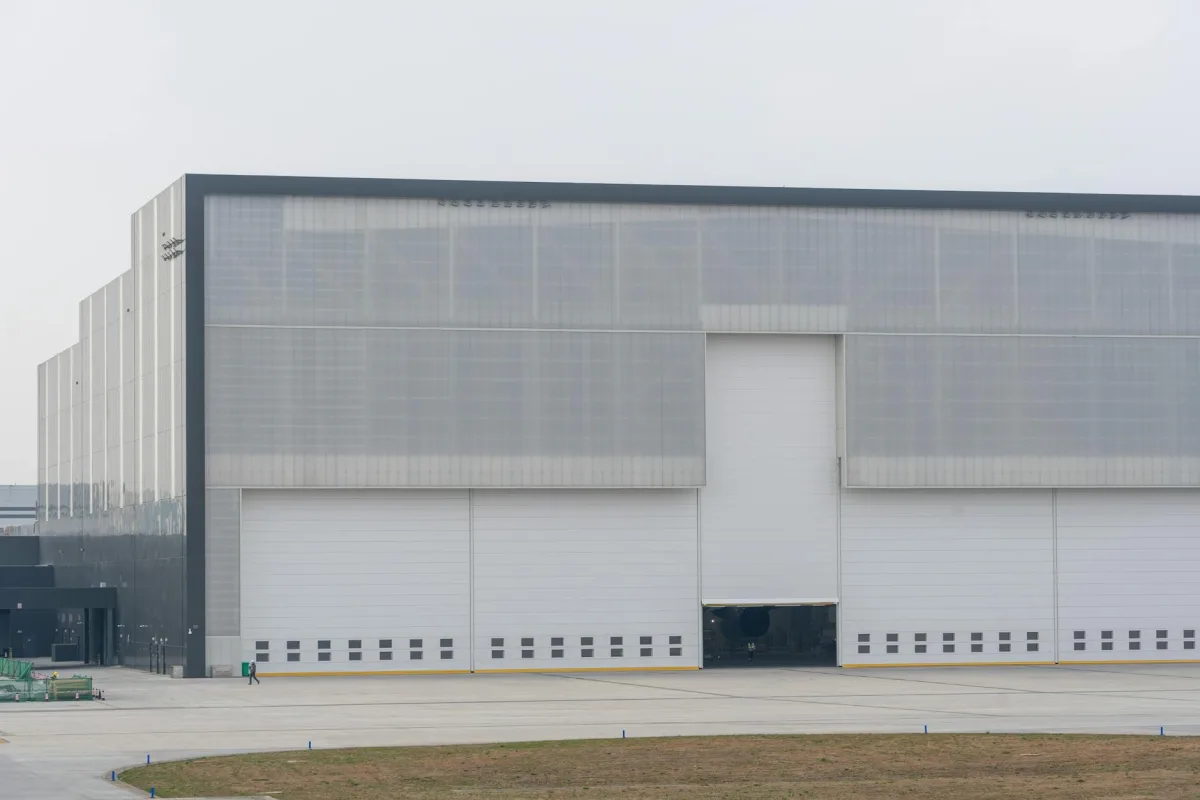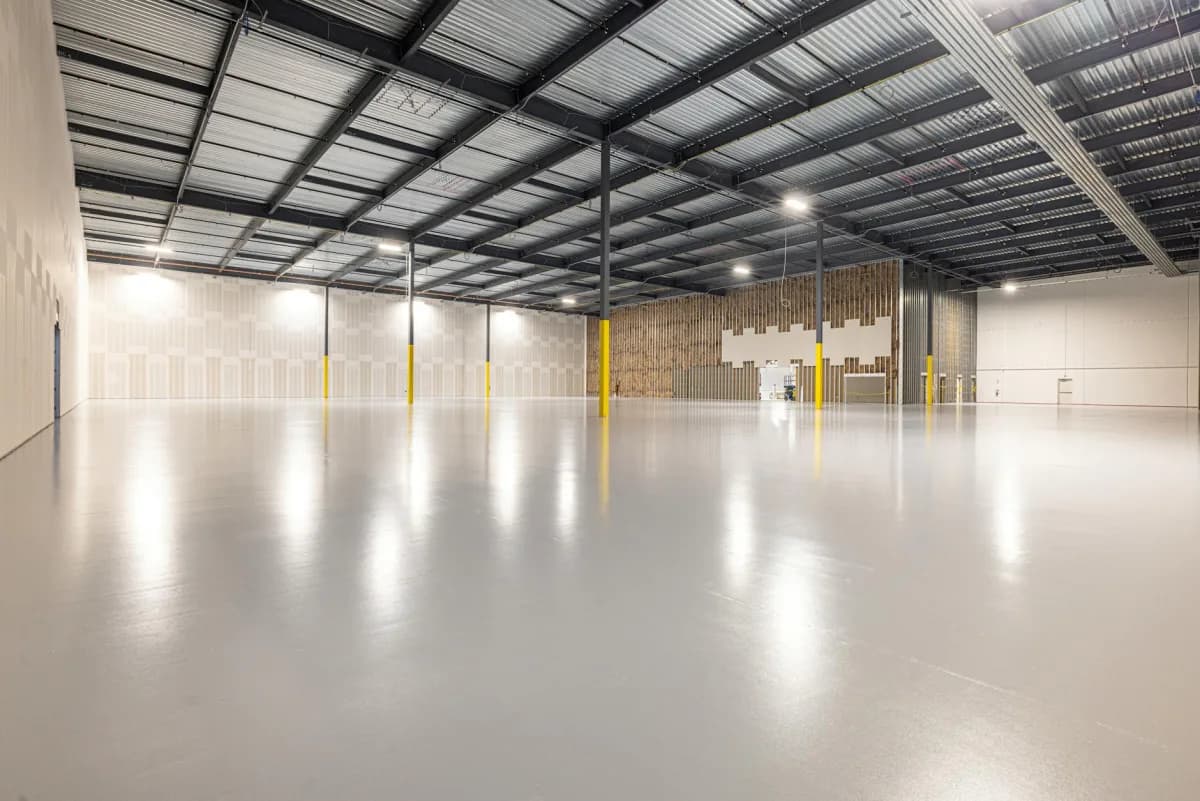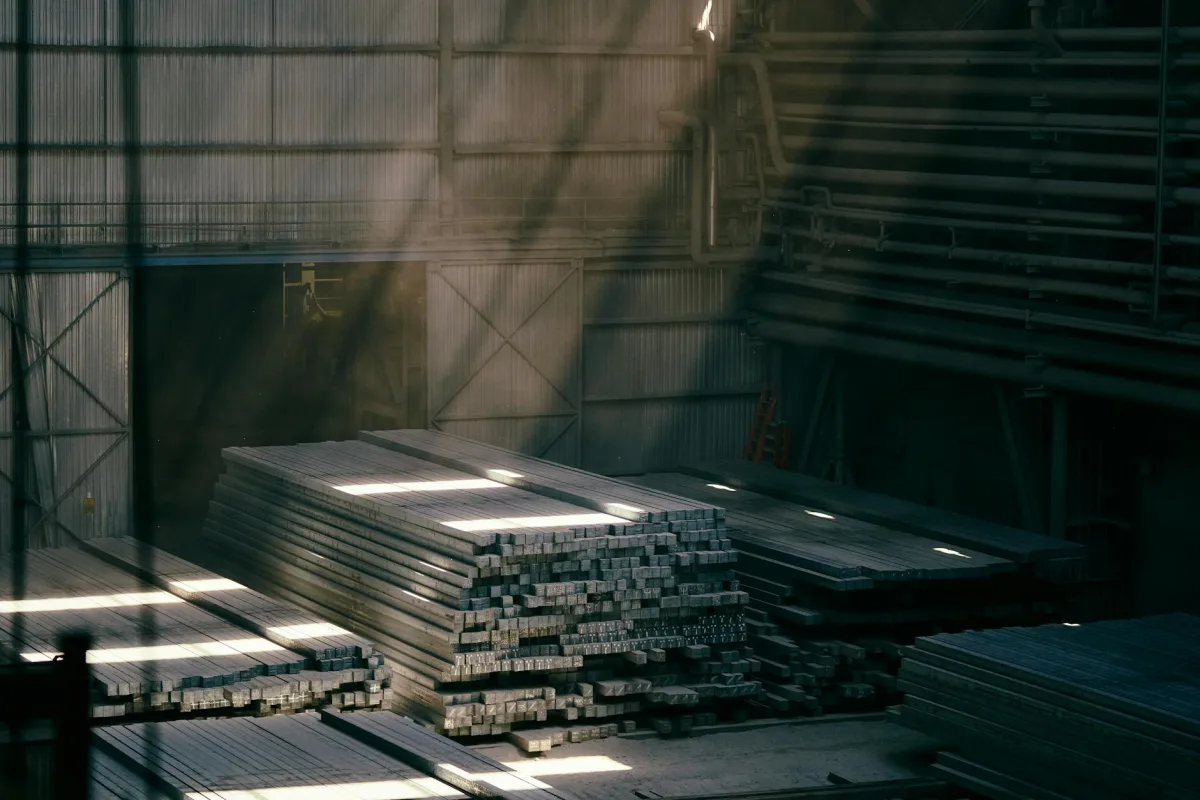
More than 90% of new warehouse facilities in Kazakhstan are built from steel structures. The reason is simple: 3–5× faster, 20–40% cheaper, and no worse in durability compared to brick or cast-in-place concrete. This article covers everything: structure types, cost by area, warehouse type selection, construction stages, and practical advice.
from 23,000 ₸/m²
cold warehouse
frame + corrugated sheet
from 65,000 ₸/m²
heated warehouse
100 mm sandwich panel, turnkey
45–60 days
construction time
1,000 m² warehouse turnkey
50 years
frame service life
with correct corrosion protection
Why Steel Structures Dominate Warehouse Construction$2
The Kazakhstani logistics and warehouse property market is experiencing active growth: according to JLL Kazakhstan data, the volume of new Class A and B warehouse construction in 2025 exceeded 600,000 m², and virtually 100% of these facilities were built from steel structures.
There are several reasons:
Speed. A cast-in-place reinforced concrete warehouse of 1,000 m² takes 12–18 months to build. A steel-frame one — 45–90 days. For a business, this means starting operations 10+ months earlier.
Economics. For the same functionality, a steel-frame warehouse costs 25–40% less than a concrete one. On a 5,000 m² project this is a difference of 100–200 M ₸.
Column-free spans. Steel allows spans of 36–60 m without intermediate columns. In concrete — a maximum of 12–18 m. A large clear span means rational shelving layout and free forklift movement.
Seismic resistance. In Almaty and other seismically active regions, steel performs better than concrete: ductility absorbs earthquake energy. SNiP RK 2.03-30-2017 explicitly recommends steel frames for seismic zones of 7+ points.
Expandability. Adding a bay, building an extension, or relocating a partition in a steel-frame building is significantly simpler and cheaper than in a brick one.
Comparison with Brick and Concrete
| Parameter | Steel frame | Brick / concrete |
|---|---|---|
| Construction time | 45–90 days | 6–18 months |
| Cost | 25–40% lower | Higher |
| Column-free span | up to 60 m | up to 12–18 m |
| Modification | Easy to expand | Difficult |
| Structure weight | Light (saves on foundation) | Heavy |
| Seismic resistance | High (ductility) | Medium (brittleness) |
| Fire resistance without protection | Lower | Higher |
Concrete outperforms unprotected steel in fire resistance. However, applying fire protection coating (intumescent paint or spray) completely resolves this issue. Fire protection cost: 800–1,500 ₸/m² of steel.
Steel Structure$2 Types for Warehouses
Hot-Rolled Structural Steel
The standard for medium and large buildings. I-beams, channels, angles. Advantage — high load capacity at relatively low weight. Used for spans of 18–60 m, heights of 6–18 m.
LSTK (Light-Gauge Cold-Formed Steel)
Profile from thin cold-rolled sheet. Used for small and medium buildings: warehouses up to 500–800 m², office annexes. 15–25% cheaper than hot-rolled steel. Limitation: span no more than 12–15 m, height up to 6 m.
Truss Structures
For large spans (24–60 m), welded metal trusses are used. They bridge large distances with less material consumption than beams. Used in logistics complexes, hangars, and production halls.
Warehouse Types: Cold, Heated, Cold Storage
Cold Warehouse (corrugated sheet, uninsulated)
For storing non-food goods, construction materials, structural steel, equipment, tyres. Minimum CAPEX, maximum construction speed. Functions as a shelter from rain and snow.
No point building a cold warehouse for: food products, pharmaceuticals, electronics, equipment with humidity requirements.
Heated Warehouse (100–150 mm sandwich panels)
Heated to +5 to +18°C. Mandatory for: FMCG logistics, pharmaceuticals, electronics, vehicle fleets. The standard for Astana and northern regions. More details on sandwich panel hangars.
Cold Storage (150–200 mm sandwich + refrigeration equipment)
Temperature ranges from +4°C (fruit/vegetables) to −25°C (deep freeze). Specialised project with specific requirements for airtightness, flooring (resistance to thermal heaving) and engineering equipment.
Warehouse Type Comparison
| Type | Purpose | Cost per 1,000 m² |
|---|---|---|
| Cold | Construction materials, steel, equipment | from 20 M ₸ |
| Heated (100 mm) | FMCG, vehicles, electronics | from 65 M ₸ |
| Heated (150 mm) | Northern regions, enhanced insulation | from 80 M ₸ |
| Cold storage (+4°C) | Vegetables, fruit, dairy | from 130 M ₸ |
| Cold storage (−20°C) | Deep freeze, meat | from 200 M ₸ |
Key Structural Elements of a Warehouse
Frame
Hot-rolled columns — vertical backbone. Trusses or portal frames — roof load-bearing elements. Purlins — secondary horizontal members. Bracing — diagonal stiffening elements. More detail in the article on building steel frames.
Roof
Profiled sheet H60–H75 — for cold warehouses. Sandwich roof 100–150 mm — for heated ones. Roof pitch in Kazakhstan — minimum 8% (5°) for organised drainage. In northern regions, design snow load per SNiP RK is 0.8–1.5 kPa.
Walls
Corrugated sheet C8–C21 — for cold warehouses. Sandwich panel PS 100–200 mm — for heated ones. 150 mm insulation is recommended for Astana, Kostanay, and Petropavlovsk.
Foundation
Monolithic strip — standard for normal soil. Pile — for weak, waterlogged, or collapsible soils. Slab — for uniform load distribution with heavy floors. Foundation type is determined based on geotechnical investigation results.
Doors
Sectional (overhead) — the standard for most warehouses. Size 4×4 m or 4×4.5 m for standard trucks. Dock doors (dock shelters) — for warehouses unloading from trailers; required for Class A.
Warehouse Floors: What to Pay Attention To
The floor is one of the most heavily loaded and expensive parts of a warehouse. Floor cost accounts for 10–15% of the total project budget.
Standard industrial floor: concrete screed M300–M400, thickness 120–150 mm, mesh or fibre reinforcement, topping. Load capacity — up to 3–5 t/m². Cost — 6,000–9,000 ₸/m².
Reinforced floor for racking storage at 10+ m height: screed 200–250 mm with enhanced reinforcement, load capacity up to 7–10 t/m². Cost — 10,000–14,000 ₸/m².
Flatness tolerance for automated warehouses — FM2 (deviation no more than 3 mm per 3 m). This requires a specialised laying technique with laser levelling.
Permit Documentation
For warehouse facilities in Kazakhstan:
- Under 500 m²: notification procedure; documents processed within 5–15 business days at the akimat.
- 500–5,000 m²: full building permit; processing time 30–60 business days.
- From 5,000 m²: state project expert review; processing time 45–90 business days.
Detailed breakdown of permits in the article turnkey warehouse construction.
Warehouse Construction Cost by Area — 2026
| Area | Cold | Heated (100 mm) | Cold storage |
|---|---|---|---|
| 300 m² | from 7 M ₸ | from 21 M ₸ | from 40 M ₸ |
| 500 m² | from 11 M ₸ | from 32 M ₸ | from 60 M ₸ |
| 1,000 m² | from 20 M ₸ | from 60 M ₸ | from 115 M ₸ |
| 2,000 m² | from 38 M ₸ | from 115 M ₸ | from 210 M ₸ |
| 5,000 m² | from 88 M ₸ | from 270 M ₸ | from 500 M ₸ |
Prices include foundation, structures and installation. Engineering services are separate (+20–30%). Steel structure prices by type — current 2026 data.
Corrosion Protection: Don't Cut Corners
A steel frame without corrosion protection in Kazakhstan's climate (harsh winters, high summer temperatures) will start corroding within 3–5 years. Correct corrosion protection delivers a 50-year service life.
Primer-enamel (2 coats): DFT from 80 µm. Cost — 800–1,200 ₸/m² of steel. Protection life — 10–15 years. Sufficient for most projects.
Hot-dip galvanising: DFT 80–100 µm of zinc. Cost 25–35% higher. Protection life — 30–50 years. Recommended for aggressive environments: agricultural facilities, food production, exposed structures.
We'll calculate a warehouse to fit your budget and purpose
Tell us the area, storage type and region — we'll prepare an estimate within 1 business day.
Frequently Asked Questions
How much does a 1,000 m² steel structure$2 warehouse cost? Cold warehouse 1,000 m² — from 20 M ₸ (structures and installation only). Heated with full engineering services turnkey — from 75–85 M ₸. The range depends on region, project complexity, and foundation type.
How long does a steel structure warehouse take to build? A standard 1,000 m² warehouse — 45–60 days from works start. Including foundation, frame and envelope structure installation. Engineering services — in parallel, no extra time with proper works organisation.
What foundation is needed for a steel warehouse? Depends on site geotechnical conditions. For most sites — monolithic strip. On collapsible or weak soils — pile foundation. Without geotechnical investigation the foundation type cannot be determined.
Can a heated warehouse be built for less than 65,000 ₸/m²? Cost can be reduced through: standard 18 m span instead of 24 m, 100 mm panels instead of 150 mm, minimal engineering services, own land without ITI. The realistic minimum is 55,000–60,000 ₸/m² with smart optimisation.
Is fire protection required for a steel frame? Under GOST 30247 and Kazakhstan fire safety standards, fire protection is mandatory for load-bearing structures. Intumescent paint EI 30 or EI 60 costs 800–1,500 ₸/m² of steel. Without it, a fire inspection certificate cannot be obtained.
Can a steel structure warehouse be expanded? Yes, a steel frame is easily expanded by adding new bays (extensions) on one or both sides. This is one of the key advantages over concrete buildings. The main requirement — when building, provide connection brackets and do not permanently seal the end wall.
How seismic-resistant is a steel warehouse? In Almaty (9 points) and Shymkent, steel-frame buildings designed to SNiP RK 2.03-30-2017 are safer than brick buildings. Steel is ductile and absorbs earthquake energy, while brick fails brittlely. In seismic zones, special design reinforcement is mandatory: diaphragms, increased cross-sections, special bolted connections.