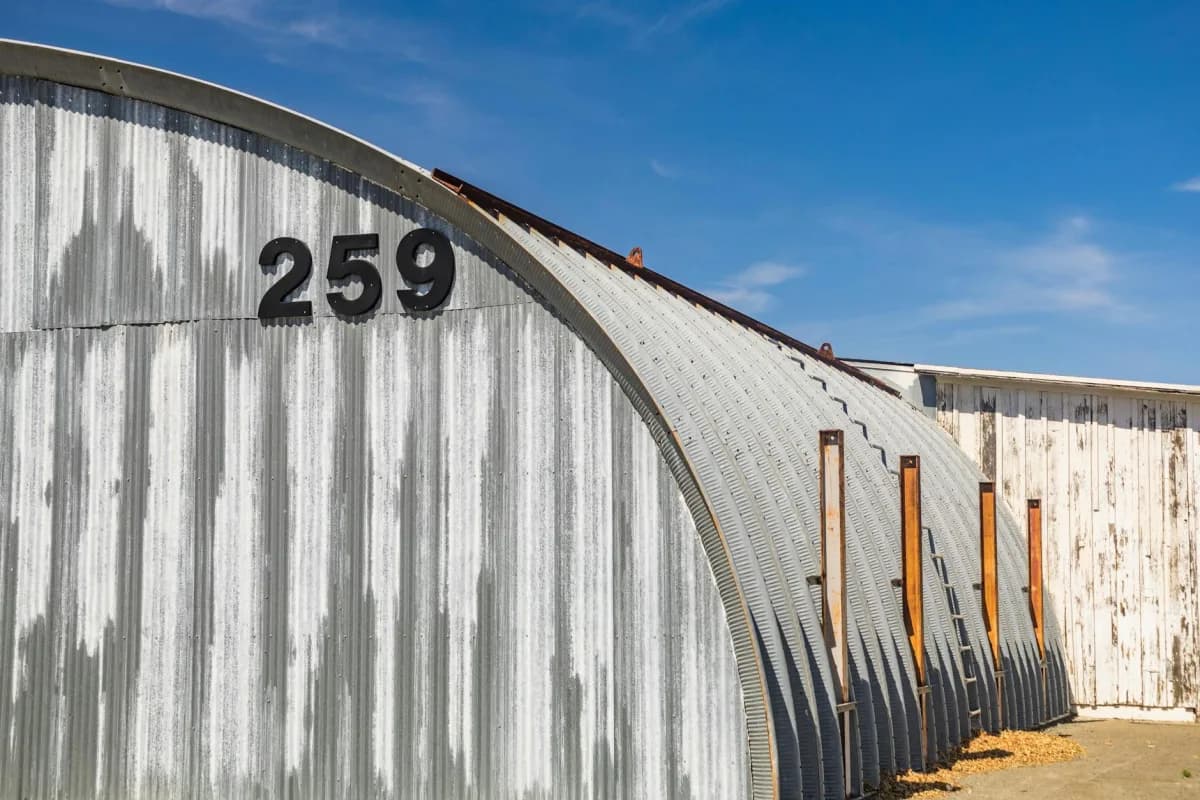
A frameless hangar is an arched structure made from cold-rolled steel profile with no internal supports. The vault simultaneously serves as both the load-bearing element and the cladding. The technology appeared in Kazakhstan in the 2000s and is now widely used in the agricultural sector, small business and for temporary structures. We cover everything: from the production technology to comparison with framed structures.
from 15,000 ₸/m²
cost
frameless, cold (uninsulated)
up to 30 m
span width
without interior columns
7–14 days
installation
for a standard size
up to 25 years
service life
with proper maintenance
How a Frameless Hangar Works: Technology from the Inside
Unlike a framed hangar where the steel frame is manufactured at a factory, a frameless hangar is produced directly on the construction site using a mobile roll-forming machine.
The process works as follows:
- A coil of cold-rolled steel 1.2–2.0 mm thick is delivered to the site.
- A mobile profile-bending machine forms an arched profile with stiffening ribs from the sheet.
- The finished arches are assembled end-to-end and bolted together — no welding required.
- Gable walls and gates are made from metal profile or sandwich panels.
Key advantage: the vault simultaneously serves as the load-bearing structure and the cladding. No columns, no trusses — just the arch. This maximises free internal space at minimum cost.
Profile Parameters
The standard frameless hangar profile has ribs 30–40 mm deep. This provides calculated resistance under a snow load of 1.0–1.5 kPa (meeting requirements for most regions of Kazakhstan per SNiP RK 2.01-19-2004).
Available spans: from 6 to 30 m. The optimal range is 12–24 m.
Where Frameless Hangars Are Used in Kazakhstan
Frameless structures are particularly popular in the following sectors:
Agriculture:
- grain, feed and straw storage (grain hangars);
- shelter for agricultural machinery (agricultural machinery hangars);
- livestock complexes.
Small and medium business:
- small warehouses 200–1,000 m²;
- car washes and small service centres;
- manufacturing workshops.
Temporary and mobile facilities:
- construction site bases during the build period;
- warehouses at remote locations;
- facilities that need to be relocated in 3–5 years.
Why people choose frameless: the combination of fast installation (7–14 days versus 30–60 for framed) and lower cost makes it attractive where there are no special requirements for height and functionality.
Detailed Comparison: Frameless vs. Framed Hangar
| Criterion | Frameless | Framed |
|---|---|---|
| Cost | 30–40% lower | Standard |
| Installation speed | 7–14 days | 30–60 days |
| Span | up to 30 m | up to 60+ m |
| Insulation | More complex and expensive | Easy (sandwich panels) |
| Wall height | Limited by arch form | Any |
| Useful height at edges | Decreases | Full across the full width |
| Expansion | Difficult (length only) | Easy (bays from any side) |
| Durability | 20–25 years | 40–60 years |
| Winter construction | Possible | Possible |
| Foundation requirement | Light | Standard |
Why Frameless Hangars Have Lower Durability
Steel thickness of 1.2–2.0 mm is substantially less than the hot-rolled sections of a framed hangar (8–25 mm). This means:
- higher corrosion risk if coating is damaged;
- lower load reserve under non-standard loads (snow build-up, impacts);
- limited service life of arch bolted connections.
With regular maintenance (annual inspection, coating renewal every 5–7 years) the actual service life is 20–25 years.
When a Frameless Hangar Is Not the Best Choice
1. Clear height of more than 5–6 m is needed across the full width. An arch provides maximum height only at the centreline. At 3 m from the edges, height decreases by 2–3 m. This limits movement of tall equipment and placement of high racking.
2. Full insulation is required. Installing sandwich panels on an arched surface is non-standard and costs 40–60% more than on the flat walls of a framed hangar. As a result, an insulated frameless hangar is often more expensive than an insulated framed one.
3. Area exceeding 1,500–2,000 m². At larger areas, a framed structure becomes comparable in price but delivers better functionality, greater height and easier expansion.
4. Large gates needed (wider than 5×5 m). The arched gable wall limits the opening size: standard 3.5×3.5 m gates fit, but 5×5 m gates require a specially engineered gable end.
5. A permanent facility with high quality requirements. For long-term investments, a framed hangar is preferable — it is easier to insure, sell or lease.
Foundation for a Frameless Hangar
Due to the light weight of the structure, the foundation for a frameless hangar is significantly lighter than for a framed one. Options:
Shallow strip foundation — the standard for facilities on normal ground. Width 300–400 mm, depth 600–800 mm. Cost — 1.5–3.5 million ₸ for a 300–600 m² hangar.
Concrete pad footings — for temporary facilities or construction on rock. The cheapest option.
Monolithic slab — if active use of the floor with machinery or heavy loads is planned. More details in the article on hangar foundations.
Insulating a Frameless Hangar: Options
If insulation is required, there are three approaches:
1. Spray polyurethane foam (SPF) applied from the inside. Applied directly to the arch. Thickness 80–100 mm. Cost — 4,000–6,000 ₸/m². Advantage: seamless coverage with no thermal bridges. Disadvantage: requires a vapour barrier finish on top, otherwise it degrades from UV exposure.
2. Soft roofing + exterior insulation. Mineral wool 100–150 mm is laid over the arch, covered with a moisture-protection membrane and metal profile. Expensive and complex, rarely used.
3. Internal timber or steel stud frame + mineral wool. A rectangular wall frame is built inside the arch and the space between the arch and the frame is filled with insulation. Essentially a warm framed perimeter inside a frameless shell. Labour-intensive, but effective.
Permits and Documentation
Frameless hangars up to 500 m² in most regions of Kazakhstan are handled through a notification procedure (no full construction permit required). Documents: notification to the akimat (local government), architectural planning brief, site plan.
For facilities from 500 m² — standard permit process (30–60 working days).
Frameless Hangar Prices in 2026
| Size | Area | Cold | With SPF Insulation |
|---|---|---|---|
| 9×18 m | 162 m² | from 2.5 million ₸ | from 4.5 million ₸ |
| 12×24 m | 288 m² | from 4–5 million ₸ | from 7–9 million ₸ |
| 15×30 m | 450 m² | from 6–8 million ₸ | from 11–14 million ₸ |
| 18×36 m | 648 m² | from 10–12 million ₸ | from 17–21 million ₸ |
| 24×48 m | 1,152 m² | from 17–20 million ₸ | from 30–36 million ₸ |
Prices are indicative. Final cost is affected by: region (delivery), gable wall complexity, foundation type and gates.
For comparison: a framed hangar of similar area costs 30–50% more, but provides full height, any type of insulation and easy expansion.
Need a hangar? We will help you choose the best structure
We will compare frameless and framed options for your project and show the real cost difference.
Frequently Asked Questions
Which is better: frameless or framed hangar? It depends on the task. Frameless wins with a budget under 15 million ₸, area up to 1,000 m², cold storage and limited height requirements. Framed is preferable for areas from 1,000 m², insulation requirements, heights of 6+ m and long-term investment.
How long does it take to install a 12×24 m frameless hangar? A crew of 4–6 installs such a hangar in 5–7 working days. Including foundation preparation (10–14 days) — 20–25 days from start to finished structure.
Will a frameless hangar survive winter in Astana? With proper design — yes. The design snow load for Astana under SNiP is 0.8–1.0 kPa. A 40 mm rib profile from 1.5 mm steel is designed for such loads. Critical: regular snow clearing during exceptional snowfall events.
Can a frameless hangar be relocated? Yes, this is one of the key advantages of the technology. Disassembly takes the same amount of time as installation (7–14 days). Up to 90% of material is suitable for reuse.
Is fire protection required for a frameless hangar? Under RK fire safety codes, load-bearing structures of a warehouse must have a fire resistance rating. However, for Class IV fire resistance facilities (agricultural, temporary) requirements are minimal. Check with the local fire inspection authority.
What is the maximum span for a frameless hangar? The technological maximum is 30 m. The most economical and reliable range is 12–24 m. Above 24 m, cost and complexity increase disproportionately and a framed option becomes more cost-effective.